

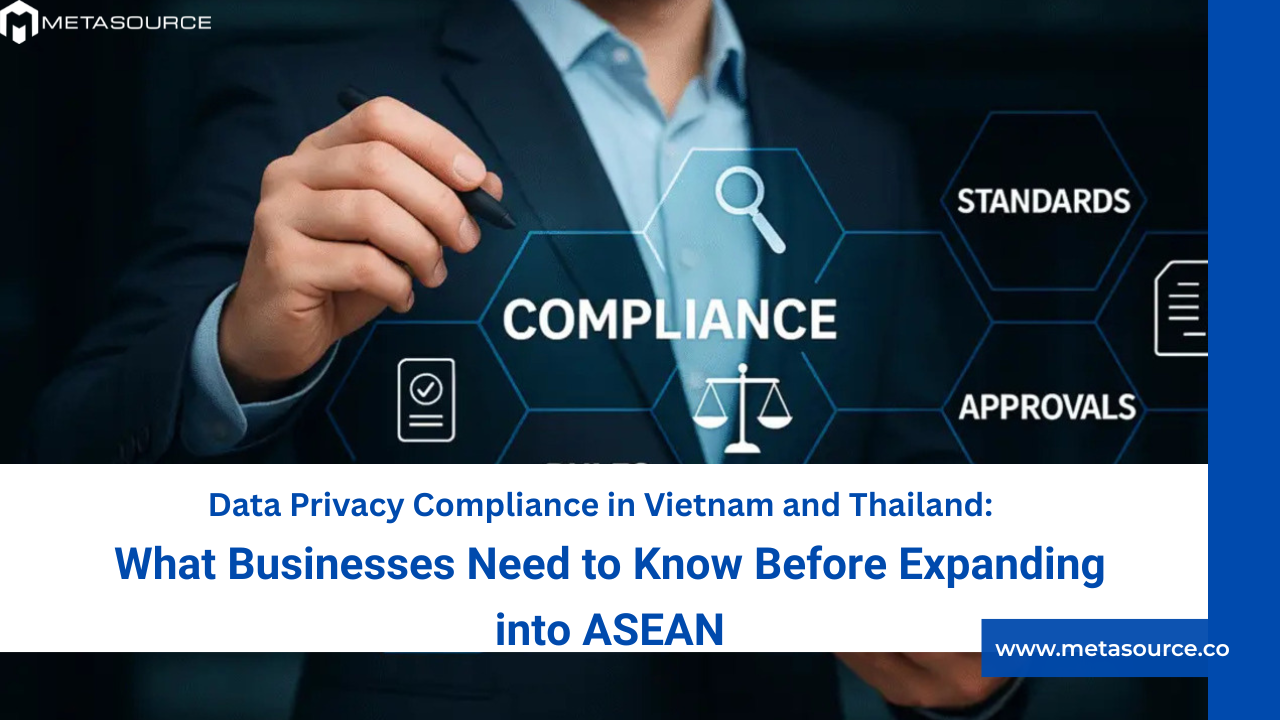
As businesses expand across Southeast Asia, regulatory compliance is no longer just a legal requirement—it has become a strategic business priority.
Whether you’re launching a new digital platform, entering a new market, or managing customer data across borders, understanding local data privacy regulations is essential. Failing to meet compliance requirements can lead to operational delays, increased business risks, and lost opportunities with enterprise clients and international partners.
Among ASEAN markets, Vietnam and Thailand have made significant progress in strengthening data privacy regulations. While both countries share the common goal of protecting personal data, their regulatory approaches and compliance expectations differ in important ways.
For business leaders, understanding these differences is the first step toward building a scalable and compliant digital operation.
1. What Is Compliance?
Compliance refers to an organization’s ability to operate in accordance with applicable laws, industry regulations, internal policies, and recognized standards.
Today, compliance extends far beyond financial reporting or tax obligations. Modern organizations are expected to address a wide range of regulatory requirements, including:
- Personal data protection
- Cybersecurity
- Anti-money laundering (AML)
- Know Your Customer (KYC)
- Corporate governance
- Risk management
For companies undergoing digital transformation, data privacy compliance has become one of the most critical areas of focus.
Every online form, customer registration, mobile application, CRM system, or cloud-based platform processes personal data. As a result, businesses are increasingly responsible for ensuring that this information is collected, stored, and used responsibly throughout its lifecycle.
2. Why Data Privacy Compliance Matters
Many organizations still view compliance as the responsibility of legal or IT teams. In reality, it has become a business-wide initiative that directly impacts growth, customer trust, and operational resilience.
Strong compliance practices help organizations:
- Reduce regulatory and operational risks.
- Build customer confidence.
- Strengthen relationships with enterprise clients.
- Meet vendor and procurement requirements.
- Support international expansion.
- Improve corporate governance.
Today, compliance is also becoming a competitive differentiator.
Large enterprises and multinational corporations increasingly assess vendors based not only on technical capabilities but also on how they manage information security, privacy, and regulatory compliance. Demonstrating mature compliance practices can significantly improve a company’s credibility during procurement and partnership discussions.
3. Vietnam: A Rapidly Evolving Regulatory Landscape
Vietnam has made substantial progress in strengthening its legal framework for personal data protection in recent years.
As digital services continue to expand, regulators are placing greater emphasis on how organizations collect, process, store, and share personal information.
This shift requires businesses to move beyond basic security measures and adopt structured governance over personal data.
Organizations operating in Vietnam should pay close attention to areas such as:
- Transparent data collection practices.
- Appropriate consent management where required by law.
- Internal data governance.
- Third-party data sharing.
- Cross-border data transfer requirements.
- Information security controls.
For many organizations, compliance is transitioning from a reactive activity into an essential component of digital business operations.
4. Thailand: Embedding Privacy into Business Operations
Thailand has established one of the region’s more mature personal data protection frameworks through its Personal Data Protection Act (PDPA).
Rather than treating compliance solely as a legal obligation, many businesses in Thailand have integrated privacy management into their day-to-day operations.
Organizations are increasingly investing in:
- Data governance programs.
- Employee awareness and training.
- Risk assessments.
- Access control management.
- Privacy policies and operational procedures.
- Ongoing compliance monitoring.
This approach reflects a broader business mindset: protecting personal data is not simply about avoiding penalties—it is about building long-term trust with customers and stakeholders.
5. Expanding Across Both Markets Requires More Than a Single Compliance Strategy
Although Vietnam and Thailand share similar objectives in protecting personal data, businesses should avoid assuming that one compliance framework can be applied universally.
Each country has its own regulatory environment, enforcement practices, and operational expectations.
Organizations expanding across ASEAN should evaluate how personal data moves throughout the business, rather than simply adapting existing policies from another market.
Business leaders should consider questions such as:
- What personal data do we collect?
- Where is that data stored?
- Who has access to it?
- Which third parties process the data?
- Do we have documented governance procedures?
- Are our systems capable of supporting audits and regulatory reviews?
Answering these questions not only supports compliance but also strengthens overall operational governance.
6. Technology Is Becoming the Foundation of Modern Compliance
As organizations grow, spreadsheets and manual approval processes are no longer sufficient to manage compliance effectively.
Modern compliance increasingly relies on technology that enables organizations to:
- Centralize policy and document management.
- Track audit trails.
- Manage user access permissions.
- Automate approval workflows.
- Monitor compliance activities.
- Maintain consent records.
- Generate compliance reports.
Embedding compliance into business systems from the beginning allows organizations to reduce operational risks while improving efficiency and scalability.
Instead of viewing compliance as an administrative burden, leading companies now treat it as part of their digital transformation strategy.
7. Final Thoughts
Compliance is no longer simply about meeting regulatory requirements.
It has become an essential capability for organizations seeking sustainable growth across Southeast Asia.
For businesses expanding into Vietnam and Thailand, investing in strong data governance and compliance practices helps reduce risk, strengthen customer trust, and improve long-term competitiveness.
As regulations continue to evolve throughout ASEAN, the most successful organizations will not be those that react to new requirements—but those that proactively build compliance into the way they operate from the very beginning.

 204C Nguyen Van Huong, Thao Dien, HCMC
 Interchange 21 - Level 33, Soi Cowboy, Bangkok
 47th Floor, Menara SMBC, Jl. DR. Ide Anak Agung Gde Agung No.5, RT.5/RW.6, South Jakarta
 Exchange Square - Level 14, Street 106 Phnom Penh