

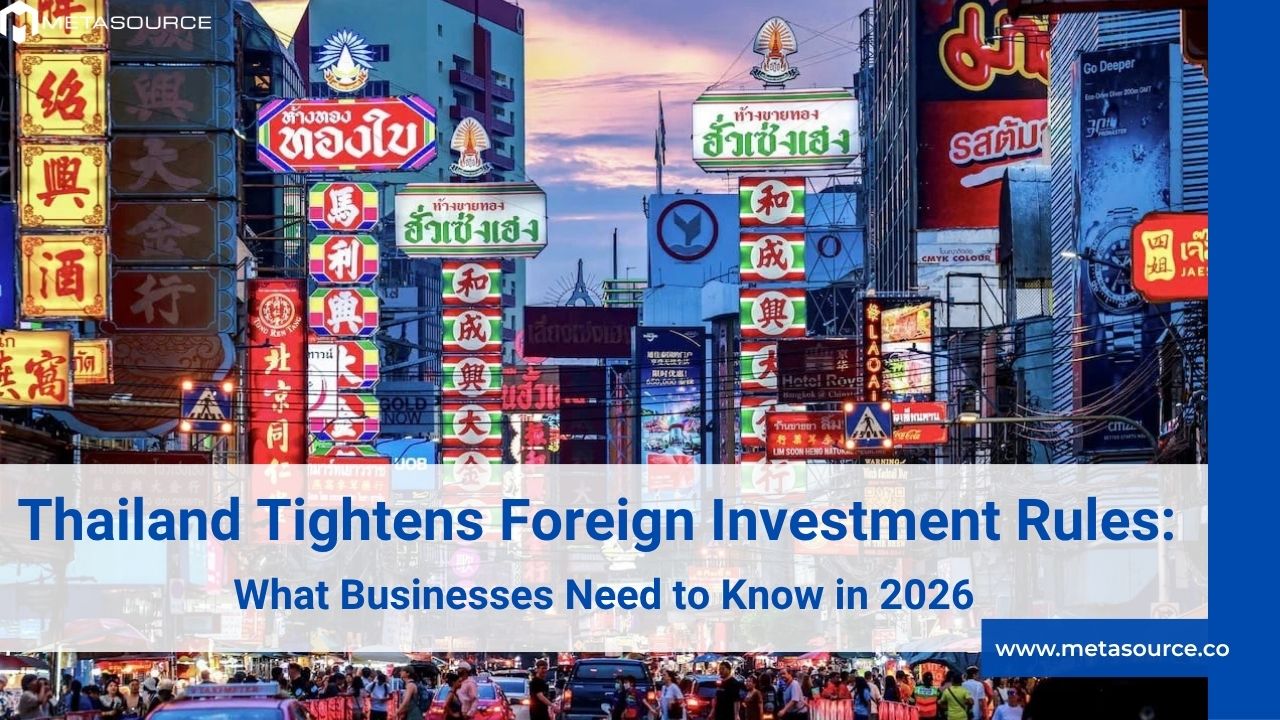
Thailand remains an attractive market for international businesses expanding into Southeast Asia. However, companies with foreign participation should be aware of new requirements introduced by Thailand’s Department of Business Development (DBD) regarding company registration and capital contributions.
Effective 1 August 2026, certain companies and partnerships involving foreign nationals are subject to additional documentation requirements. The new rules focus on verifying that capital contributed by Thai shareholders is genuine and can be traced through banking records.
For businesses planning to establish or restructure a company in Thailand, this means that having a compliant shareholding structure on paper may not be enough. The underlying investment should also be properly documented.
I. What Has Changed?
The key change is greater scrutiny of the source and flow of capital.
Previously, Thai shareholders were generally required to provide their own bank statements as evidence of their investment. Under the new requirements, authorities may also review the company’s bank account and documentation showing how the funds moved from each Thai shareholder to the company.
Depending on the registration or amendment, businesses may need to provide:
- Bank statements of each Thai shareholder covering the three months before the capital subscription date
- Bank statements of the company’s account receiving the capital contributions
- An Investment Explanation Letter explaining the flow of funds from each Thai shareholder to the company
This allows the authorities to verify not only who owns the shares, but also who actually provided the money for those shares.
II. Who May Be Affected?
The requirements apply to certain company and partnership registrations involving foreign participation, including situations where:
- A foreign national holds less than 50% of the registered capital as a shareholder or partner
- A Thai company has no foreign shareholders but appoints a foreign national as an authorised director
- An existing company or partnership introduces a foreign national as a minority shareholder, partner or authorised signatory
The exact documentation required may vary depending on the type of registration or corporate amendment.
III. Why Is Thailand Tightening the Requirements?
The new measures are closely related to concerns around nominee shareholding.
A nominee arrangement can occur when Thai individuals appear as majority shareholders on paper, while the actual funding or control comes from a foreign investor.
For example, a company may be registered with 51% Thai ownership and 49% foreign ownership. If the Thai shareholders did not actually provide the funds for their shares, however, the registered structure may not accurately reflect the underlying investment.
By checking bank statements and capital flows, the authorities can obtain more evidence about whether Thai shareholders have made genuine investments.
For legitimate businesses, the practical message is straightforward: shareholding, capital contributions and financial records should be consistent and properly documented.
IV. What Should Businesses Do?
Companies with Thai-majority ownership and foreign participation should consider reviewing their corporate structure and financial records before submitting a new registration or amendment.
In particular, businesses should check:
- Shareholder structure
Does the registered ownership accurately reflect the actual investment arrangement? - Capital contributions
Can each Thai shareholder demonstrate that they have genuinely provided their stated capital? - Banking records
Are there clear and traceable records showing the movement of capital from shareholders to the company? - Future corporate changes
Could planned share transfers, capital increases or changes to authorised directors trigger additional documentation requirements?
Preparing these documents in advance can help businesses avoid unnecessary delays during registration.
V. What Options Are Available for Foreign Investors?
The new requirements do not mean that foreign investment in Thailand is prohibited. Foreign investors can still explore different legal structures depending on their business activities and circumstances.
Potential routes may include a Foreign Business Licence (FBL), Board of Investment (BOI) promotion, or other properly structured investment arrangements that comply with Thai regulations.
The appropriate option depends on factors such as the business activity, ownership structure and applicable foreign investment restrictions. Businesses should obtain professional legal advice before deciding on a corporate structure.
Key Takeaways
Thailand’s latest registration requirements reflect a stronger focus on transparency in foreign investment and corporate ownership.
For businesses entering or operating in Thailand, the main considerations are:
- Ensure that the shareholder structure reflects genuine investment.
- Keep clear records of capital contributions and banking transactions.
- Review existing structures before making significant corporate changes.
- Consider the appropriate legal route for foreign investment from the beginning.
Taking a proactive approach to corporate compliance can help businesses reduce administrative delays and build a more sustainable foundation for their operations in Thailand.
Expanding Your Business into Thailand or Southeast Asia?
Setting up a business in a new market involves more than company registration. Businesses also need to consider HR, recruitment, payroll, immigration and ongoing compliance.
At Metasource, we support companies expanding across Vietnam and Southeast Asia with:
- Employer of Record (EOR)
- Payroll & Accounting
- Recruitment
- Immigration & Work Permit Support
- HR Outsourcing
- Company Registration & Market Entry Support
Whether you are hiring your first employee or building a larger regional operation, local support can help simplify your expansion process.
📩 info@metasource.co
🌐 metasource.co
This article is for general informational purposes only and does not constitute legal advice. Businesses should seek professional advice regarding their specific investment and corporate structure in Thailand.

 204C Nguyen Van Huong, Thao Dien, HCMC
 Interchange 21 - Level 33, Soi Cowboy, Bangkok
 47th Floor, Menara SMBC, Jl. DR. Ide Anak Agung Gde Agung No.5, RT.5/RW.6, South Jakarta
 Exchange Square - Level 14, Street 106 Phnom Penh