

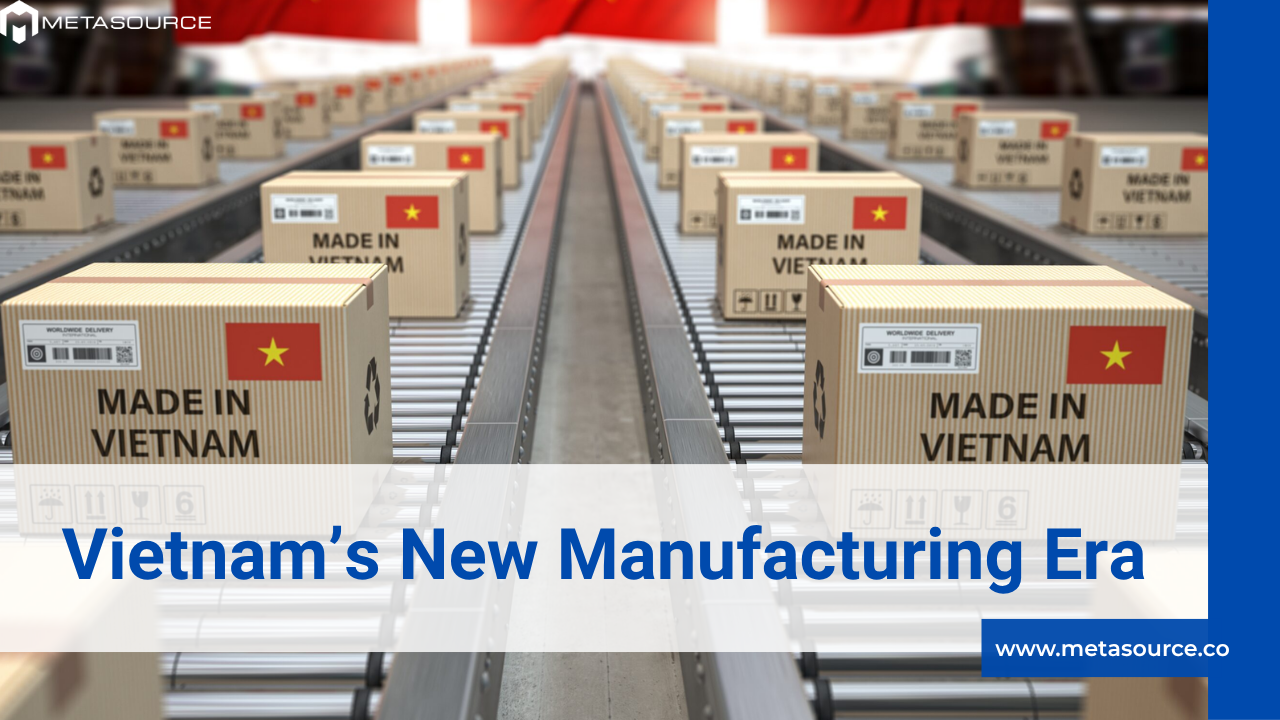
Vietnam has become one of Asia’s important manufacturing hubs, attracting global companies with competitive labor costs, industrial infrastructure, strategic location, and growing integration into regional supply chains.
However, the Vietnam manufacturing industry is evolving.
For companies planning to manufacture or expand operations in Vietnam, cost is no longer the only consideration. Businesses are increasingly looking at the broader operating environment, including supply chains, technology, infrastructure, compliance, sustainability, and access to talent.
The key question is becoming:
Can Vietnam support our business for the long term?
1. Manufacturing in Vietnam: From Cost Advantage to Operational Capability
Competitive labor costs remain an important factor for companies considering manufacturing in Vietnam, but they are no longer the only factor influencing investment decisions.
Global manufacturers are facing changing trade policies, supply chain disruptions, geopolitical uncertainty, and increasingly demanding customer requirements. Changes such as the global minimum tax are also influencing how companies evaluate investment incentives and operating costs.
As a result, companies need to consider the full operating environment before establishing a manufacturing operation in Vietnam.
Key questions include:
- Can materials and components be sourced locally?
- Can products move efficiently through the logistics network?
- Is the required skilled workforce available?
- Can the factory meet international quality and compliance standards?
- Can the operation scale as the business grows?
These factors are becoming increasingly important alongside labor and land costs.
2. Strengthening Supply Chains in Vietnam
Supply chain localization is another important consideration for manufacturers entering Vietnam.
Rules of origin and local value creation are becoming increasingly relevant for companies serving international markets. Simply importing components, carrying out basic assembly, and exporting finished products may not always be sufficient to meet customer or market requirements.
This creates opportunities for businesses to develop more of their supply chain in Vietnam, including:
- Components and raw materials
- Packaging
- Supporting products
- Local suppliers
- Manufacturing and technical services
For Vietnam, this creates an opportunity to move beyond final assembly and become a deeper part of regional and global manufacturing networks.
For companies, developing a stronger local supply chain can also improve resilience, supplier access, and operational flexibility.
3. Technology and ESG Are Reshaping Vietnam Manufacturing
Technology is changing the way modern factories operate.
Automation, robotics, digital production systems, and advanced manufacturing equipment are increasingly being introduced into production environments. As factories become more technology-driven, the workforce they require is also changing.
Modern manufacturing operations need more than production workers. Companies may also need:
- Industrial and manufacturing engineers
- Automation engineers and technicians
- Quality professionals
- Supply chain specialists
- Production managers
- Technical specialists
- Finance and HR professionals
At the same time, ESG in manufacturing is becoming increasingly relevant to global supply chains.
Energy efficiency, waste management, water treatment, renewable energy, workplace conditions, and environmental standards can all influence supplier selection and investment decisions.
For manufacturers serving international customers, sustainability is increasingly becoming part of operational planning rather than a separate initiative.
4. Infrastructure and Location Matter
Location remains an important factor when choosing where to establish a manufacturing operation in Vietnam.
Companies need to consider more than industrial land. They also need reliable access to:
- Roads and transportation networks
- Ports and logistics services
- Electricity and other utilities
- Suppliers and supporting industries
- Customers and export markets
- Skilled labor
Northern Vietnam, particularly the Hanoi–Bac Ninh–Hai Phong corridor, has developed into an important manufacturing and logistics area.
In Southern Vietnam, Ho Chi Minh City and surrounding industrial areas continue to play an important role in manufacturing, supporting industries, logistics, and business services.
However, infrastructure alone does not determine the success of a manufacturing operation.
5. Talent Is a Critical Part of Manufacturing Expansion
A modern factory needs the right people to operate, manage, and improve its processes.
Companies entering Vietnam may need to recruit across multiple functions, including:
Engineering | Production | Quality | Supply Chain | Sales | Finance | HR | Management
This means workforce planning should begin alongside the investment and market-entry plan—not only after the factory becomes operational.
For international companies, finding people who understand both local business practices and international working environments can also be an important part of building a successful local operation.
Recruitment, EOR and HR Outsourcing for Companies Entering Vietnam
Building a full local operation from day one may not always be the most practical approach for companies entering the Vietnamese market.
Some businesses want to test the market or hire a small local team before establishing a larger operation. Others already have a Vietnamese entity but need additional support as their workforce grows.
This is where Recruitment, Employer of Record (EOR), and HR Outsourcing in Vietnam can provide practical support.
Recruitment
Professional recruitment support can help international companies identify and hire qualified local talent across technical, commercial, and corporate functions.
Employer of Record (EOR)
An EOR in Vietnam can provide a flexible employment solution for companies that are not yet ready to establish their own legal entity or need support managing local employment requirements.
HR Outsourcing
HR outsourcing in Vietnam can support day-to-day workforce administration, including payroll, employee documentation, HR processes, and other administrative requirements.
At Metasource, we support international companies expanding in Vietnam through Recruitment, EOR, HR Outsourcing, Payroll, Accounting, and Immigration services.
Whether you are hiring your first employee, building a local team, or expanding an existing operation, having the right people and HR structure can make your Vietnam market entry easier to manage.
Vietnam as a Long-Term Manufacturing Destination
Vietnam is no longer simply a low-cost manufacturing destination.
It is becoming an increasingly important part of regional and global supply chains, with opportunities across manufacturing, supporting industries, technology, logistics, and business services.
For companies planning to expand manufacturing operations in Vietnam, the question is not only where to manufacture, but also how to build the right operation, supply chain, and team for long-term growth.
If your company is planning to enter or expand in the Vietnamese market, Metasource can support you with Recruitment, EOR, HR Outsourcing, Payroll, Accounting, and Immigration services.
📩 info@metasource.co
🌐 metasource.co

 204C Nguyen Van Huong, Thao Dien, HCMC
 Interchange 21 - Level 33, Soi Cowboy, Bangkok
 47th Floor, Menara SMBC, Jl. DR. Ide Anak Agung Gde Agung No.5, RT.5/RW.6, South Jakarta
 Exchange Square - Level 14, Street 106 Phnom Penh